
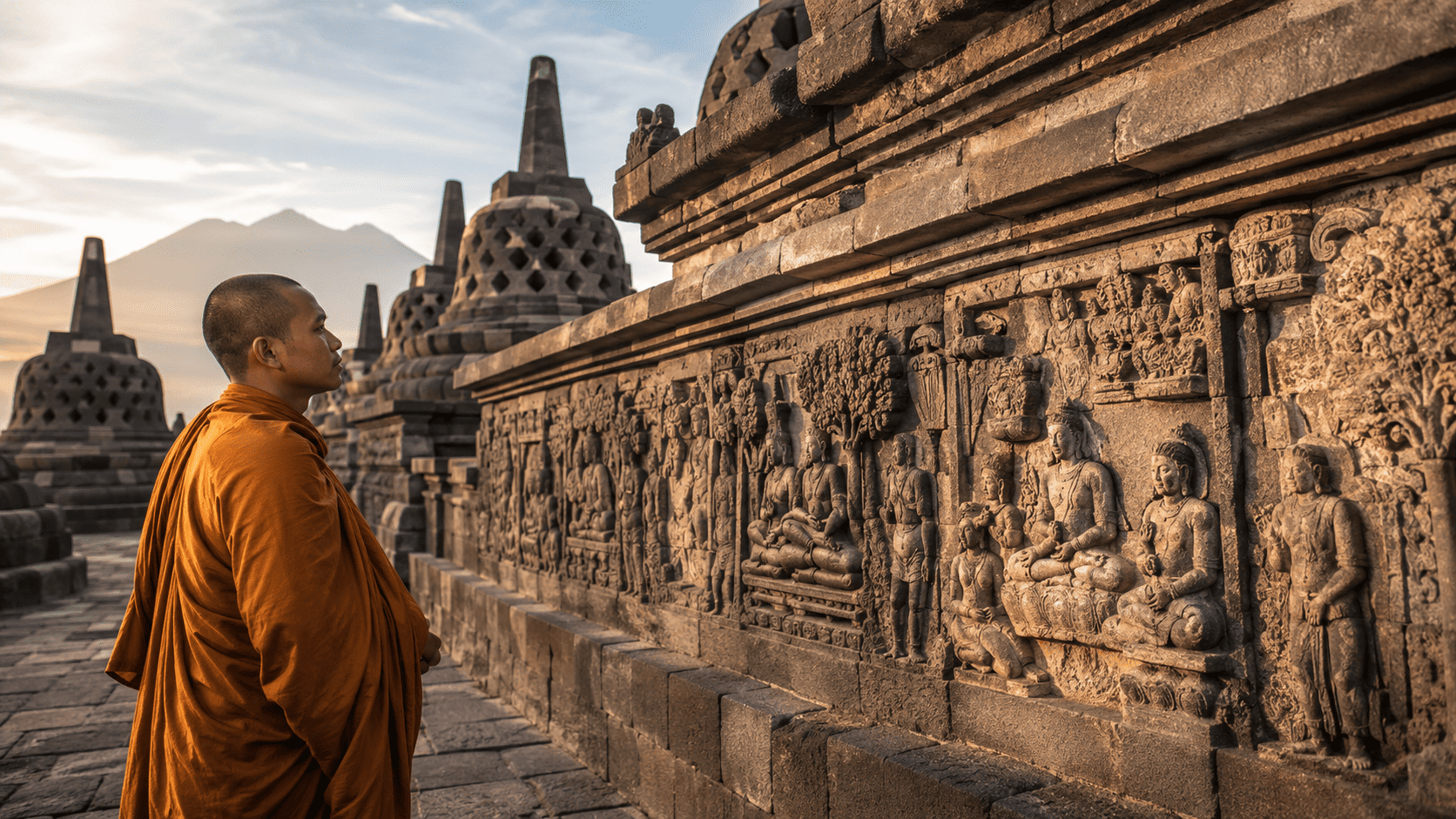
The Borobudur Temple Reliefs Meaning becomes clearer when you see the monument as a visual journey. Its carved panels do more than decorate the walls. They teach Buddhist ideas, describe moral choices, and show scenes from everyday life. Visitors who follow the galleries slowly can read Borobudur almost like a stone storybook.
Why Are Borobudur Reliefs Important?
Borobudur contains 1,460 narrative relief panels and 1,212 decorative panels. These carvings cover the walls and balustrades across several levels. UNESCO also records about 2,520 square meters of relief surfaces across the monument.
The reliefs guide visitors through stories about karma, the life of the Buddha, previous lives, and the search for wisdom. Their placement follows the upward movement through Borobudur. This connection between art and architecture gives the carvings a deeper religious purpose.
Karmawibhangga and the Law of Karma
Karmawibhangga appears at the hidden foot of Borobudur. Its 160 panels show actions and their consequences. The scenes explain how good and harmful behavior can produce different results.
This section reflects the Buddhist idea of karma. It reminds visitors that actions carry moral consequences. The carvings present familiar human experiences, helping visitors grasp the Buddhist lessons more clearly.
Buddha’s Journey in the Lalitavistara Reliefs
The Lalitavistara panels portray key episodes from Siddhartha Gautama’s life as he progressed toward enlightenment. These carvings highlight major stages in his spiritual journey and the events that shaped his path to Buddhahood.
Visitors can follow these scenes while moving through the gallery. The sequence turns the temple wall into a visual narrative. A guide can help identify characters and explain how each scene connects with Buddhist teachings.
For more background on the monument, read our guide to facts about Borobudur Temple. It explains Borobudur’s history, architecture, Buddhist meaning, and other important details.
Jataka and Avadana Stories
Jataka stories describe previous lives of the Buddha. Many scenes focus on generosity, compassion, patience, and moral choices. Avadana stories also highlight virtuous actions and their results.
These stories make the reliefs easier to connect with daily life. Instead of presenting Buddhist philosophy only through abstract ideas, the artists used people, animals, journeys, and social situations.
Gandavyuha and the Search for Wisdom
Gandavyuha follows Sudhana, a young seeker who meets many teachers during his spiritual journey. Each meeting adds another lesson to his search for understanding.
This theme fits Borobudur’s upward design. Visitors move physically through the monument while the story describes spiritual progress. The relationship between movement and narrative strengthens the temple’s symbolic meaning.
How to Read the Reliefs During a Visit
Traditionally, visitors follow the reliefs clockwise, starting from the eastern side. Moving slowly helps you notice clothing, buildings, ships, animals, and other details carved into the stone.
Do not rush directly to the upper stupas. The galleries contain much of Borobudur’s storytelling and artistic detail. Travelers who want more context can choose a private Borobudur tour with local guidance. A knowledgeable guide can connect individual scenes with the larger Buddhist journey.
Conclusion
The Borobudur Temple Reliefs Meaning comes from the stories, moral lessons, and spiritual ideas carved across the monument. Karmawibhangga explains karma, Lalitavistara follows the Buddha’s life, while Jataka, Avadana, and Gandavyuha explore virtue and wisdom.
Take time to study the galleries during your visit. Once you understand their purpose, the reliefs become more than decoration. They become a visual path through Buddhist teaching and human experience.
